Strung Across Centuries: The Ukrainian Beaded Necklace That's Quietly Inspiring a New Generation of American Crafters
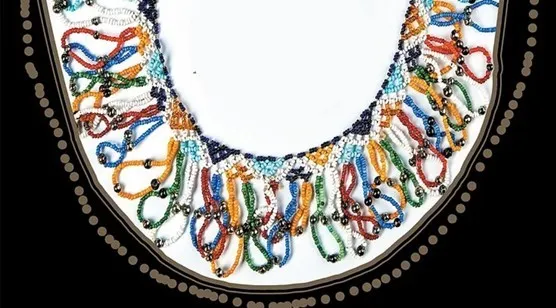
Photo: Міністерство культури та інформаційної політики України, CC BY 4.0, via Wikimedia Commons
There's a word you might not have heard before — gerdan — but if you've spent any time in niche craft corners of the internet lately, chances are you've seen one without knowing it. A flat, intricately beaded collar or necklace, traditionally made by Ukrainian artisans using tiny glass seed beads woven on a loom, the gerdan is one of those objects that stops you mid-scroll. The geometry is precise. The color combinations are almost aggressively beautiful. And once you learn what it is and where it comes from, it's hard to look away.
This site takes its name from that object. And that's not an accident.
What Exactly Is a Gerdan?
The word itself comes from the Turkish gerdanlık, meaning necklace or throat adornment — a linguistic artifact of the Ottoman Empire's long reach into Eastern Europe. But the Ukrainian gerdan evolved into something distinctly its own. Traditionally worn by women in the Carpathian regions of Ukraine and across the broader Ukrainian countryside, gerdans were woven from hundreds — sometimes thousands — of tiny glass beads into wide, flat bands that draped across the chest and shoulders like a collar of stained glass.
The patterns weren't random. Regional designs carried specific meaning. Certain color combinations signaled a village of origin, a marital status, a season, or a celebration. A gerdan was, in the most literal sense, a wearable text — a piece of clothing that communicated identity to anyone who knew how to read it.
Historians trace the craft's recognizable form back roughly 500 years, though beadwork traditions in the region are considerably older. What makes the gerdan distinct from other Eastern European folk embroidery traditions is the loom-weaving technique, which creates that characteristic flat, almost architectural structure. It's not strung like a typical bracelet. It's built.
Surviving Everything
Here's the part that gives the gerdan its weight: this craft didn't survive 500 years by staying comfortable. Ukrainian folk traditions, including beadwork, were actively suppressed during the Soviet era. Anything that looked too specifically Ukrainian — too regionally distinct, too tied to pre-Soviet identity — was politically inconvenient. Artisans kept the knowledge alive in small ways, passing techniques through families, tucking patterns into memory.
After Ukrainian independence in 1991, there was a significant cultural revival. Folk crafts came back into the open. Younger Ukrainian artists began reinterpreting traditional designs with contemporary color palettes and modern materials. The gerdan, once a rural heirloom, started showing up in urban galleries and fashion editorials.
Then came 2022, and with it, a global surge of interest in Ukrainian culture. People who had never thought twice about Eastern European folk art suddenly wanted to understand what Ukraine actually was — its history, its aesthetics, its traditions. Craft communities online became unexpected classrooms.
The American Discovery
For young Americans — particularly those with Ukrainian heritage, but also those with no direct connection at all — the gerdan arrived at a peculiar cultural moment. Gen Z has grown up in the middle of an ongoing, often exhausting conversation about cultural appropriation. The question of who gets to wear or make what, and under what circumstances, is something this generation takes seriously in a way previous ones largely didn't.
And yet that same generation is also deeply hungry for authentic cultural objects. Not fast fashion. Not algorithmically generated aesthetics. Something with a story long enough to outlast a trend cycle.
The gerdan threads that needle in an interesting way. Unlike, say, a sacred ceremonial object, the gerdan was always partly a public-facing, shareable form of beauty — made to be seen, admired, and yes, replicated. Ukrainian artisans and cultural organizations have largely welcomed international interest in the craft, especially in the past few years, viewing it as a form of cultural solidarity rather than extraction. Learning to make a gerdan, or even just wearing one purchased directly from a Ukrainian maker, has become a small act of engagement with a living culture rather than a fossilized one.
What the Craft Actually Demands
Let's be honest about something: making a gerdan is not a beginner project. The loom-weaving technique requires patience, precision, and a willingness to count — obsessively, repeatedly — tiny beads in specific sequences. A finished gerdan can take anywhere from several hours to several weeks depending on complexity. The learning curve is real.
That difficulty is, weirdly, part of the appeal for a lot of younger crafters. In a culture of instant output, there's something almost radical about committing to a project that cannot be rushed. You can't shortcut the bead count. You can't undo a weaving mistake without unraveling significant work. The gerdan demands your full attention, and in return it gives you something that looks and feels genuinely handmade — because it genuinely, painstakingly is.
Craft educators in the US who have started incorporating gerdan-making into workshops report that students are often surprised by how meditative the process becomes. The repetitive counting, the careful threading, the slow accumulation of pattern — it hits a similar neurological sweet spot as knitting or embroidery, but with the added layer of cultural context giving each session a sense of purpose beyond the object itself.
Heritage Without Gatekeeping
One of the more interesting dynamics in the American gerdan revival is how it's playing out across heritage lines. Ukrainian-American communities — which are substantial, particularly in cities like Chicago, Cleveland, and New York — have embraced the renewed interest as a bridge between generations. Grandmothers who kept beading supplies in shoeboxes under their beds are suddenly being sought out by grandchildren who want to learn. Cultural centers that once struggled to attract young members are running out of seats in beadwork workshops.
But non-Ukrainian Americans are also showing up, and the reception has been largely warm rather than territorial. The prevailing attitude in most Ukrainian craft communities seems to be: learn the history, credit the source, engage respectfully, and welcome. That's a more nuanced position than the culture-war version of appropriation debates often allows for, and it's one that feels genuinely generative.
Why This, Why Now
The gerdan's American moment isn't happening in isolation. It's part of a broader shift in how young people are relating to craft — not as a hobby, but as a form of cultural literacy. Making something by hand that carries centuries of meaning is a different experience than making something decorative. It asks you to think about where you are in a longer story.
For a generation that grew up with unprecedented access to information about the world and an equally unprecedented sense of disconnection from it, that feeling of being inside a tradition — even briefly, even as a student or an admirer — matters more than it might seem.
The gerdan is beautiful. That's where most people start. But the reason they keep coming back to it, keep learning it, keep talking about it, is something harder to photograph: the sense that this small, intricate, bead-by-bead object has been carrying meaning across centuries, and that you are, for a moment, part of that chain.
That's worth stringing together.