Why Knitting Might Actually Be Fixing Gen Z's Brain (No, Really)
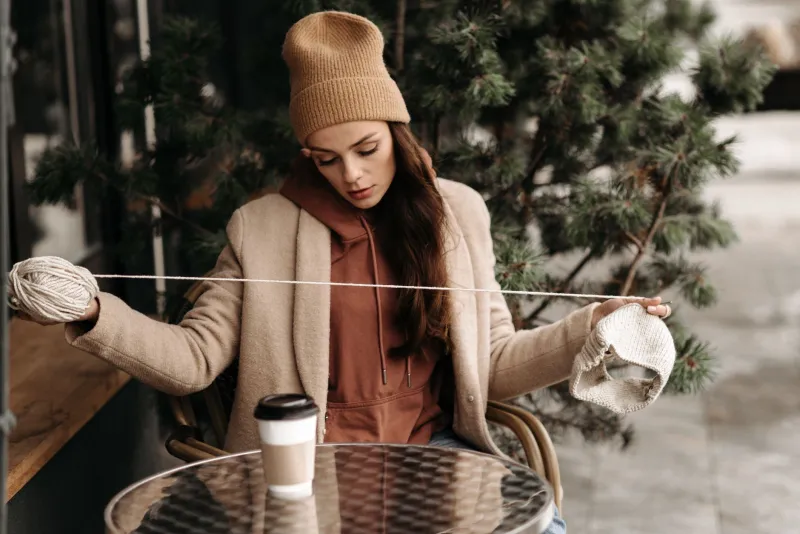
There's a scene that keeps playing out in coffee shops, college dorm common rooms, and community centers across the country: a 23-year-old, hoodie up, AirPods in, quietly knitting. Maybe it's a lumpy scarf. Maybe it's something more ambitious — a sweater sleeve, a tote bag worked in chunky cotton. Whatever it is, the person making it looks, against all odds, genuinely calm.
In a generation defined by its relationship with anxiety, that calm is worth paying attention to.
Fiber arts — knitting, crocheting, weaving, embroidery, macramé — have been having what the internet keeps calling a "moment" for a few years now. But to dismiss this as a trend, a quirky aesthetic phase between sourdough and cold plunging, is to miss something more interesting happening underneath. Researchers, therapists, and the young people themselves are starting to articulate what, exactly, these ancient crafts are doing to the modern brain. And the answer is more neurologically specific than you might expect.
Your Brain on Yarn
Here's the basic science: repetitive, rhythmic hand movements — the kind you make when you're knitting row after row or weaving a pattern back and forth — activate the parasympathetic nervous system. That's the "rest and digest" counterpart to the fight-or-flight response that most of us are running on basically all the time. When your hands are busy with something tactile and patterned, your cortisol levels tend to drop. Your heart rate follows.
But it goes further than simple relaxation. Occupational therapists have long used craft-based activities in clinical settings because they engage what's sometimes called "bilateral coordination" — the brain's two hemispheres working in tandem. Some researchers compare the cognitive state produced by repetitive handwork to certain forms of meditation, specifically the kind that anchors attention to a physical sensation rather than a breath or a mantra.
Then there's dopamine. Every completed stitch, every finished row, every project that goes from a skein of raw yarn to an actual wearable object delivers a small, reliable hit of that feel-good neurotransmitter. In a digital environment where dopamine is largely tied to unpredictable social validation — a like here, a comment there — fiber arts offer something genuinely different: a reward system you actually control. You do the work, you get the payoff. No algorithm involved.
For a generation that grew up inside those algorithms, that distinction matters enormously.
The Loneliness Problem Nobody Wanted to Admit
Gen Z is, statistically, one of the loneliest generations on record. This is a finding that has shown up across multiple large-scale studies, and it tends to surprise people who assume that a generation raised on social media must be drowning in connection. The reality is more complicated. Digital socialization — fast, frictionless, always available — turns out to be a pretty poor substitute for the kind of slow, embodied togetherness that humans are actually wired for.
Fiber arts communities, both online and off, seem to be quietly solving for this. Yarn shops across the US have seen a surge in drop-in knitting circles and beginner crochet nights, many of them drawing crowds that skew noticeably younger than the stereotype would suggest. Ravelry, the fiber arts social network that's been around since 2007, has seen a meaningful uptick in younger members. On TikTok and Instagram, craft content creators in their early twenties have built followings in the hundreds of thousands by simply filming themselves making things and talking honestly about why they started.
What's interesting about these communities — and what therapists who work with young adults are starting to note — is the quality of the connection they produce. When people sit together and make things with their hands, conversation tends to go deeper, faster. There's something about having a shared, low-stakes task that dissolves the social performance anxiety that can make direct interaction feel so exhausting. Your hands are busy. The pressure's off. You can actually talk.
"It Gave Me Something to Show Up For"
Ask young fiber artists why they started, and you'll hear variations on the same few themes: burnout, anxiety, a desire for something real. Ask them why they stayed, and the answers shift. It's the community. It's the feeling of making something that exists in the physical world. It's the satisfaction of a skill that deepens the more you practice it — something increasingly rare in a culture of instant everything.
Many describe a specific cognitive relief that comes from working on a pattern that requires just enough concentration to quiet the mental noise without demanding so much focus that it becomes stressful. Knitters sometimes call this the "sweet spot" — a project that's engaging but not overwhelming. Neurologically, this maps onto what psychologist Mihaly Csikszentmihalyi famously called "flow": that absorbed, timeless state where challenge and skill are perfectly matched.
Flow states, it turns out, are genuinely hard to access on a phone. The constant context-switching of social media — notification to notification, app to app — is almost structurally opposed to the sustained, single-point attention that flow requires. A pair of knitting needles, by contrast, is a fairly reliable flow machine once you get past the learning curve.
The Therapist's Take
Mental health professionals who work with Gen Z clients have started incorporating craft-based interventions more deliberately, and many report that the results are hard to argue with. There's a clinical term — "behavioral activation" — for the therapeutic strategy of engaging in purposeful, rewarding activity to counteract depression and anxiety. Fiber arts check nearly every box: they're accessible, they're portable, they produce tangible results, and they're inherently social if you want them to be.
Some therapists also point to the way craft reconnects people to their bodies. After years of living primarily through screens — working, socializing, consuming, creating — many young adults have developed a kind of disconnection from physical sensation. The textures of yarn, the resistance of a weaving loom, the precise pressure of a crochet hook: these are grounding in a literal, sensory sense. They pull attention back into the present moment in a way that's not unlike what mindfulness-based therapies aim to achieve, but often with less of the self-consciousness that formal meditation can trigger in younger people.
Making Something That Lasts
Maybe what fiber arts are really offering Gen Z is a different relationship with time. In a culture optimized for speed and immediacy, choosing to spend twenty hours making a sweater is almost a countercultural act. It says, quietly, that some things are worth the slow way. That the process has value, not just the outcome. That your hands know things your phone doesn't.
That's not a small shift. And if the neuroscience is right — if all those repetitive, meditative hours are genuinely reshaping dopamine pathways, rebuilding the capacity for sustained attention, and creating the conditions for real human connection — then maybe the most radical thing a stressed-out 22-year-old can do right now is pick up a skein of yarn and figure out where to start.
The lumpy scarf is optional. The rewiring is apparently included.