Knotted, Gifted, Worn: How Friendship Bracelets Became Gen Z's Most Meaningful Currency
The Bracelet You Can't Screenshot
There's something quietly radical about handing someone a knotted piece of string. No algorithm curated it. No brand stamped it. It took actual time — your time — and now it lives on another person's wrist. For a generation that grew up watching relationships perform themselves on social media, that kind of gesture hits differently.
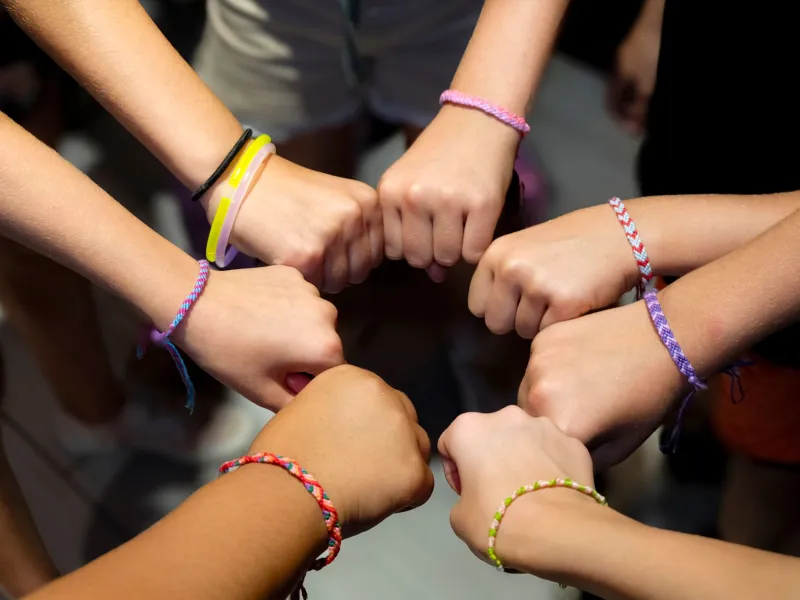
Friendship bracelets have surged back into American cultural life with a force that's hard to ignore. Walk into any major music festival, linger near the floor at a Taylor Swift or Olivia Rodrigo concert, or scroll through the right corners of TikTok, and you'll find them everywhere: stacked on forearms, traded between strangers, photographed with the kind of reverence usually reserved for vintage jewelry. This isn't a simple nostalgia trip. Something more interesting is going on.
From Summer Camp to Sold-Out Shows
The modern friendship bracelet revival didn't come from one single moment — it built slowly, then all at once. Swifties turned bracelet trading into an unofficial ritual at The Eras Tour, arriving with stacks of handmade pieces and leaving with ones from people they'd just met. The practice spread fast, partly because it was documented obsessively online, but also because it offered something concerts had been missing: a reason to talk to the stranger next to you.
Jamie, a 22-year-old from Austin who's been making bracelets since middle school, described the exchange as "basically the only time I've ever introduced myself to someone I didn't already know online." She showed up to a show with forty bracelets and left with thirty-seven new ones. "I wore them for weeks. It felt wrong to take them off."
That feeling — the reluctance to remove something a stranger made for you — is worth sitting with. It points to something deeper than trend-following.
Why Handmade Feels Like a Statement Now
Cultural analysts have started paying attention. Dr. Priya Mehta, who studies youth identity and material culture at a university in Chicago, sees the bracelet boom as part of a broader pushback against the frictionless nature of digital connection. "There's a fatigue with things that are easy," she explained in a recent conversation. "Liking a post costs nothing. Making something with your hands, giving it away — that's a form of vulnerability. Gen Z is hungry for that."
The handmade quality is part of the point. Imperfection signals authenticity. A slightly uneven knot, a color combo that only makes sense to two specific people, initials worked into the pattern — these aren't bugs, they're the whole feature. Mass-produced friendship jewelry exists, obviously, but it doesn't carry the same charge. You can feel the difference on your wrist.
This is also why the bracelets function as social currency in a way that purchased accessories simply can't. At festivals like Coachella or Bonnaroo, trading bracelets has become its own subculture — a parallel economy running on time, skill, and goodwill rather than money.
The Craft Itself Is Having a Moment
It's not just the gifting that's resonating. The act of making has pulled in a whole separate audience. Bracelet tutorials are among the most-watched craft content on TikTok and YouTube, with creators breaking down macramé knots, chevron patterns, and letter beading techniques to audiences in the millions. Craft supply stores have reported steady increases in embroidery floss sales, and small Etsy shops selling pre-cut kits have carved out loyal customer bases.
Marcus, a 19-year-old from Philadelphia who started making bracelets during his sophomore year of high school, calls it "the only thing I do that doesn't involve a screen." He makes them while watching TV, during long phone calls, on the bus. "It's like doodling, but you end up with something you can give someone."
That dual nature — meditative process plus meaningful product — might explain why the hobby has stuck around beyond a single viral moment. It satisfies the urge to make and the urge to connect at the same time.
Strings Attached (In the Best Way)
There's a psychological thread running through all of this that's worth naming directly. Gift-giving researchers have long noted that handmade presents carry disproportionate emotional weight compared to their material value. The time embedded in the object communicates care in a way that even an expensive purchase can't replicate. For Gen Z, a cohort that grew up watching relationships get flattened into follower counts and reaction emojis, a bracelet made specifically for you represents a kind of proof.
"It's like someone saying: I thought about you while I was doing something else," said Jamie. "That's rare now."
The bracelets also resist the ephemerality that defines so much of online social life. A story disappears in twenty-four hours. A bracelet doesn't — or at least, you choose when to take it off. There's agency in that. Wearing someone's bracelet is an ongoing act of acknowledgment, visible to everyone who looks at your wrist.
Not Just for the Girls
One thing worth noting: the current wave of bracelet culture has shed a lot of its gendered baggage. While friendship bracelets were historically coded as a girls' craft, the current revival is markedly more inclusive. Male and nonbinary makers are prominent in online communities, and the trading culture at concerts tends to be refreshingly indifferent to who made what for whom.
This shift matters because it signals that the appeal isn't really about the object itself — it's about what the object does. It creates a moment of genuine human contact. It asks for nothing in return. It says: here, I made this, it's yours.
A Small Thing That Means a Lot
Friendship bracelets will never solve loneliness, and they're not trying to. But in a cultural moment defined by disconnection anxiety — the nagging sense that we're more "connected" than ever and somehow lonelier for it — there's real meaning in reaching for something tactile and giving it away.
Gen Z didn't invent this. They inherited it from summer camps and playgrounds and their own childhoods. What they've done is recognize that it still works — maybe more than most things do — and build something around it. A few strands of colored thread, knotted tight, passed from one hand to another.
Simple. Imperfect. Irreplaceable.